Responding, Not Reacting: How I Stopped Letting My Business Define Me
The rule I live by
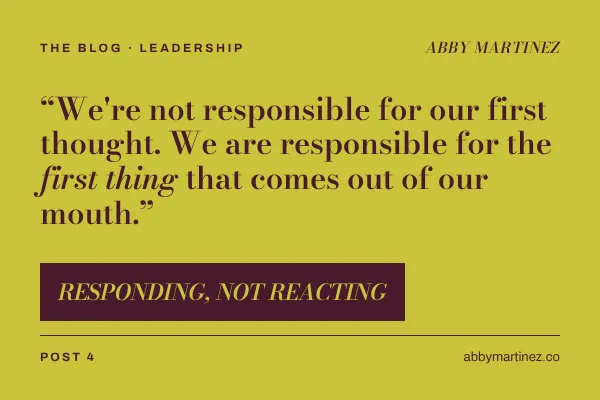
We are not responsible for our first thought, but we are responsible for the first thing that comes out of our mouth. That one belief has changed how I lead, how I handle hard conversations, and how I show up for my clients and team.
It didn’t come naturally. In the season I describe in There Is No Destination, a tough client email could send me straight into panic. My first thought was always some version of what did I do wrong, it’s me, I’m the problem, and I acted on it immediately.
Why the same email lands differently on different days
How I respond depends a lot on what kind of day I’m already having. Some days I open a hard email and I can read it and still feel okay. Other days I haven’t gotten enough rest, I’m tired, or I’m just off, and I feel a lot more emotionally attached to what’s on the screen.
That’s not a character flaw, it’s capacity. Your nervous system has more room to work with on some days than others. Knowing that about myself means I don’t expect to feel nothing. I just expect myself to notice what I’m bringing to the moment.
What I actually do now: I take a beat
On the good days and the hard days, I take a beat before I respond. I want to respond in integrity, and that means seeing the situation from all sides, not just the side my first reaction is shouting about. I still have feelings. Sometimes they get hurt. I’m human, and I’m not pretending otherwise.
If it’s a bad enough situation, I take a real break. I’ll walk away from my desk and come back when I can think clearly. Customer service is at the heart of what we do as a service business, and my clients deserve a response from the steady version of me, not the panicked one.
The real shift: my identity is not my business
The beat only works because something deeper changed. My identity is not my business. It isn’t in who said what, how a client feels about us this week, or how much money I’m making. When I know where my identity actually lives, a hard email is a problem to solve, not a verdict on my worth.
That’s the core of why I say your nervous system is your business operating system. When your sense of self is fused to the business, every problem feels like a threat. When it isn’t, you can separate yourself from the problem, look at it from a different perspective, and respond in a way you’re proud of.
Problems are part of the work
After six years of doing this, I’ve stopped expecting a season with no problems. We’re humans working with humans, so there will always be new situations to work through. I’ve come to see those moments as the way this work teaches us to be better people and better leaders.
That lesson got tested hardest once I had a team, and I write about it in You Don’t Have a Hiring Problem, You Have a Leadership Problem.
Frequently asked questions
How should a business owner respond to an upset client?
Take a beat before replying, look at the situation from every side, and respond in integrity with customer service at the center. If you’re too activated to do that, step away first.
What does respond, don’t react mean?
It means pausing between the first feeling or thought you have and the action you take, so your words come from a steady place instead of from fear or defensiveness.
How do you separate your identity from your business?
Get clear on where your worth actually comes from, then practice noticing when a client comment, a slow month, or a mistake starts to feel like a statement about who you are.
Do regulated founders still get upset?
Yes. Regulation isn’t feeling nothing. It’s having enough capacity to notice the feeling, take a pause, and choose your response.
Want to see how much capacity you’re really working with? Start with my free guide, The Capacity Audit, and if you’d like support leading from a steadier place, book a discovery call.
On Purpose,
Abby
About the author
Abby Martinez is a fractional COO, ICF certified coach, former teacher, and President of FemCity Des Moines. She’s the founder of Well Balanced Business, and she helps women founders build businesses that run on solid systems and a regulated nervous system instead of hustle.